Don't Know What to Do? a Simple Way to Find Your Next Step
If you don't know what to do, learn how to name the real problem, sort your options and choose one small next step you can take today.

There's a document open on your laptop. It might be a business plan with three sections finished and a blank space where the numbers go. It might be a job listing you've read six times without applying. It might be an empty page and a blinking cursor, and the only thing you can say for certain is that you don't know what to do.
So you close the laptop. You tell yourself you'll come back to it with a clearer head, and tomorrow evening the same thing happens, in the same chair, with the same result.
That loop feels like a personal failing. Most of the time it isn't. "I don't know what to do" is a symptom rather than a diagnosis, and it has at least five different causes: an outcome you can't name, too many options, conditions that keep shifting, an emotional block, or work that has stopped feeling supported and meaningful. Each cause needs a different first move. Apply the wrong one and you get motion without progress.
Find Out What Kind of Stuck You Are
Say the sentence out loud to a friend and it usually narrows into something specific. "I don't know what to do about the business" turns into "I don't know whether to hire" or "I don't know if this is still worth doing." The vague version feels enormous because it hasn't been divided yet.
It also isn't rare, and it isn't a flaw in your character. In the American Psychological Association's 2021 Stress in America survey, run online by The Harris Poll among 3,035 U.S. adults, 32% said they were sometimes so stressed by the COVID-19 pandemic that they struggled with basic decisions such as what to wear or eat, and 63% said uncertainty about the next few months caused them stress (APA, Stress in America 2021). A mind that grinds on what to eat will grind harder on what to do next.
Treat the feeling as a signal to diagnose, not an instruction to try harder. Match what you notice to a row below, then take that row's first move.
Five kinds of stuck and the first move for each
| Type of stuck | What it sounds like | First move |
|---|---|---|
| Unclear outcome | "I want something different but I can't name it" | Write one sentence describing the result you want |
| Too many options | "Every path looks equally good or equally bad" | Cut the list to three options |
| Uncertain conditions | "My income, timing or role might change" | Sort the choices into reversible and irreversible |
| Emotional block | "I dread starting and keep putting it off" | Name the feeling and shrink the first task |
| Missing support or meaning | "I feel alone with this and the work feels empty" | Talk to one trusted person and test one small change |
Pick the row that sounds most like you on a bad evening, not the one you think you should be in. Someone who is genuinely isolated at work will not fix it by writing a better goal statement, and someone with a foggy outcome will not fix it by joining a networking group.
How to Name the Outcome and Your Limits
A foggy decision gets lighter once two nouns are on paper: the result you want and the limits that bind it. If your diagnosis row was an unclear outcome, this is the repair move. If it was fear or overload, the same page still helps, because even a rough target shows which worries are real and which are noise.
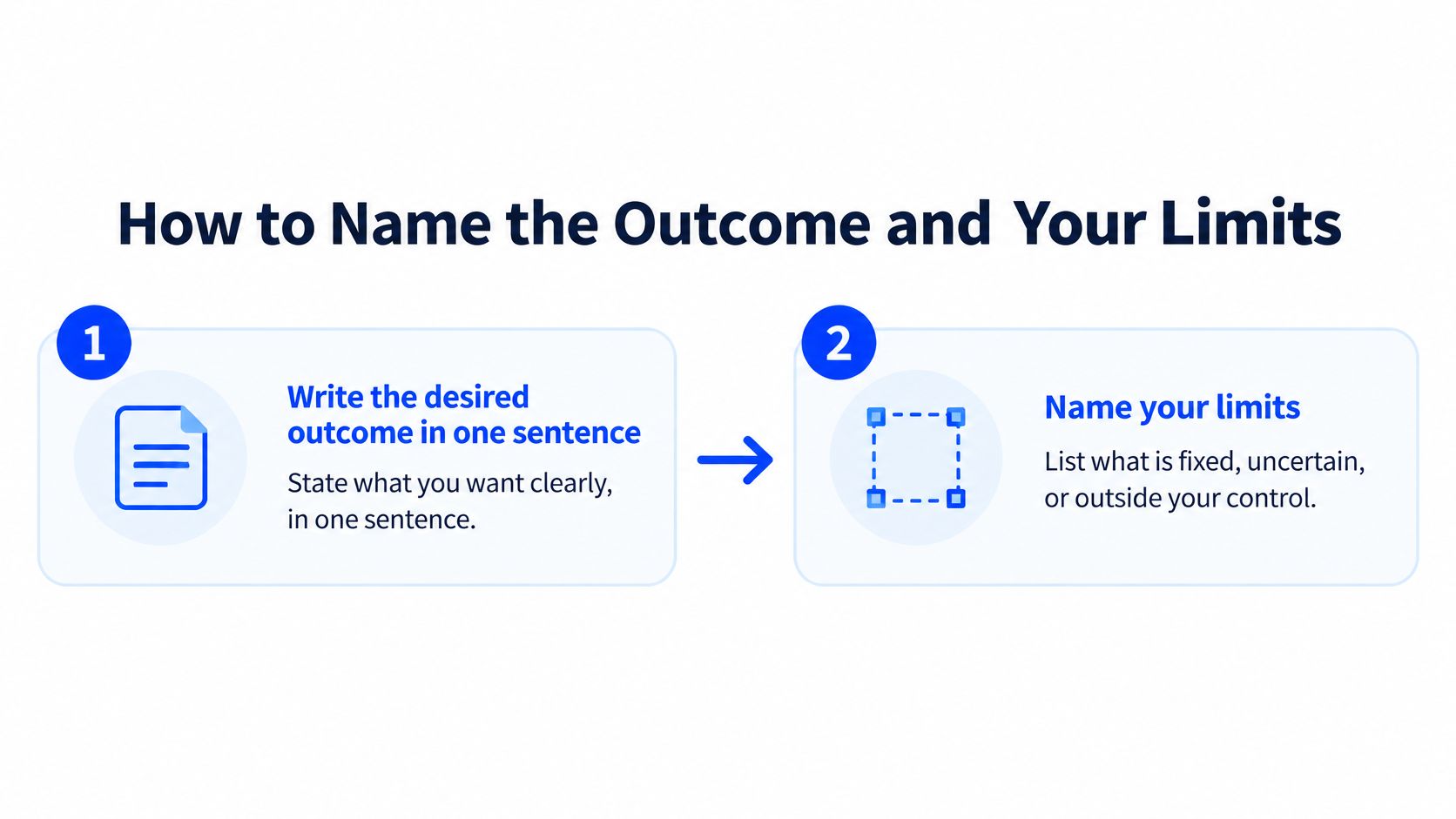
Start with the outcome sentence. Make it plain enough to say out loud: "I want a job where I write for a living by next spring," or "I want the studio to cover its own costs by December." The deadline can stay loose, but the direction needs to be testable. That sentence becomes the filter for later choices, which is why a vague wish makes every path look equally promising and equally risky.
Then list the limits that bind. Use five headings: hours per week, money you can risk over six months, skills you already have, obligations you cannot move, and whether a wrong choice can be undone. Limits work like the edges of a map. They mark the roads that were never open, so the remaining roads get easier to compare.
This order fits a broad finding in goal-setting research: specific goals tend to support better follow-through than vague intentions. Treat the practical sequence here as a working method you can adjust. Keep the target near-term and clear, because unstable conditions punish plans that pretend to know too much too early.
Where the first two steps go wrong
- An outcome that is really a fear. "I don't want to fail at this" or "I don't want to end up stuck here" gives you nothing to move toward. Rewrite it as the result you want, not the one you're avoiding.
- A limit you assumed instead of checked. Believing a course is unaffordable without looking up the price, or assuming you have four hours a week when you have one, sends the whole plan sideways. Check the number before you build on it.
- A plan that reaches too far. A detailed three-year roadmap built on assumptions you can't verify today will need rewriting in a month, and the rewriting is what makes people quit.
If the limits list keeps growing until everything feels fixed, the piece on handling competing priorities shows how to separate the commitments that determine the question from the ones that only feel urgent.
Before you move on, check the page for two things: one outcome sentence you could test against options, and three to five limits you confirmed rather than guessed.
Sort Options by Whether You Can Undo Them
Three to five options is the right number, and the reason is not about thoroughness. Past five, the comparison itself becomes the thing you're avoiding.
There's a broader reason to take the sorting seriously. In a 2025 Intuit survey, 69% of respondents said the financial environment made long-term planning feel out of reach, rising to 75% among Gen Z and 68% among Millennials (Intuit's 2025 Prosperity Index). When income, work, housing or retirement assumptions can move under you, refusing to commit to one fixed path is reasonable processing of real information. It isn't a lack of ambition. The answer isn't a bolder plan. It's a set of choices sorted by what happens if you're wrong.
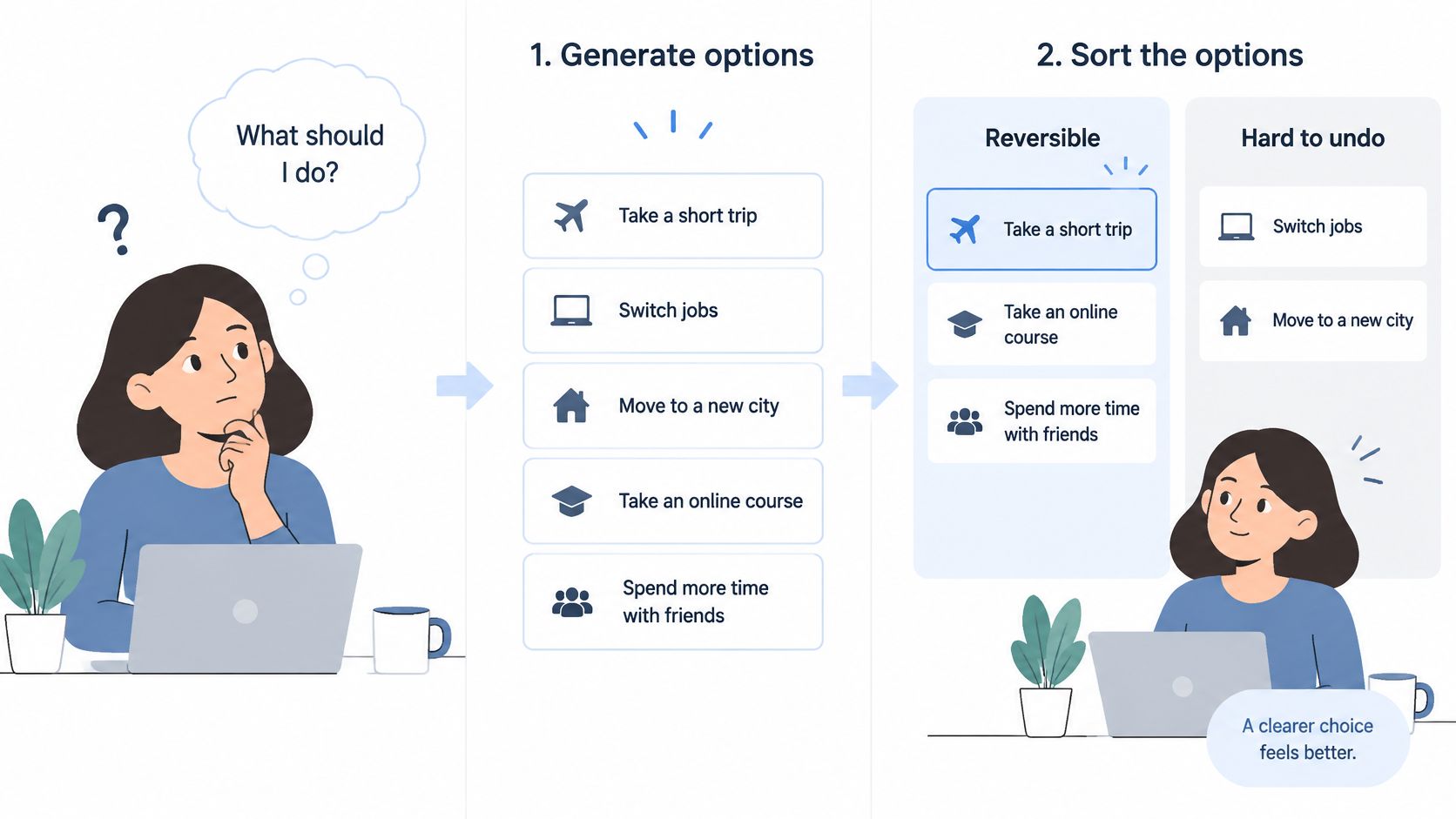
List three to five feasible options, including the option of waiting two weeks. Waiting is a real option and often the right one, as long as you name what you're waiting to learn rather than drifting.
Mark each one reversible or irreversible. Reversible means you can undo it in days or weeks at low cost. Irreversible means money, reputation or relationships are on the line. Most career moves land somewhere in between, and knowing which side they sit on tells you how much testing they deserve.
Choose two or three criteria before you look at the list. Cost, energy required, and fit with the outcome you wrote are enough. Picking criteria after you've seen the options is how people end up justifying the choice they already wanted.
Reversible or irreversible choices and how to test them
| Choice | Reversible? | How to test it cheaply |
|---|---|---|
| Taking a short course | Yes | Enrol in one module and review the result |
| Trying a new tool | Yes | Use it for one week on a real task |
| Pitching a new client | Yes | Send three proposals and track replies |
| Quitting a job | No, hard to undo | Talk to two people in the target role and run a small side project first |
| Signing a long lease | No | Ask for a shorter term or a break clause |
Reversible choices get tried this week. Irreversible ones get a cheap test first.
If the reason a reversible option keeps sitting there untouched is fear of failure, the test stays the same: make the first attempt small and private enough that failing costs almost nothing. Choose the option that keeps more doors open while still producing evidence you can use.
Pick the Smallest Next Action and Review It
A decision only becomes real when it turns into something you can do on a Tuesday morning. That means an action small enough to fit in 10 to 30 minutes, not a project you'll start "properly" next month.
Do this in four steps.
- Pick the top-scoring option from your list.
- Write the action in one line with a day and a time. Not "work out my career" but "open the application and fill in the first two fields, Thursday 8pm."
- Set a review date one or two weeks out and put it in the same calendar.
- At the review, write down what happened and what got in the way. Time ran short? The task was too big? Your energy was gone by the evening?
A designer who wants to move into product work writes "draft three questions for two product managers, Tuesday at 9am" instead of "figure out my career." The line is dull. It's also the only version that produces a result, because at 9am on Tuesday there is a specific thing to do or not do.
The trap here is research that feels like progress. Reading another article about career transitions, comparing two more tools, waiting until you feel certain: none of it counts as a started action. Track what you planned against what you began. The gap between those two lists shows you where the friction sits, and the fix is usually a smaller task, a different time of day, or a changed environment. More willpower rarely fixes it.
When the block is emotional rather than logistical
Sometimes the task is clear, small and scheduled, and you still don't start. That's the emotional row of the table, and it needs its own sequence.
Write down the avoided task, the feeling attached to it (dread, fear of being judged, wanting it to be perfect) and the expectation behind the feeling. Then reduce the task to a concrete starting behavior, schedule it at a specific time, and remove one immediate distraction before you sit down. Afterwards, record whether you did it and what the barrier turned out to be.
A meta-analysis of 12 randomized controlled trials covering 646 participants found a large overall effect for structured procrastination interventions, with a Hedges' g of 1.18. Results vary a lot by format and delivery, and a separate trial that randomized 2,209 students found a single session of digital feedback didn't shift self-reported procrastination at all. One reflection exercise won't do it. Treat it as a trial and adjust.
Check Whether Focus Is the Real Problem
A stuck feeling can come from the conditions around the work as much as from the choice itself. If the room is loud, the work feels pointless, or no one ever sees what you produce, a clearer pros and cons list may still leave you unable to begin.
Gallup's global figures found that only 20% of employees were engaged, while 64% were not engaged and 16% were actively disengaged (Gallup, State of the Global Workplace). People building a business alone can face a quieter version of the same problem: fewer chances to test thinking, less feedback, and longer gaps between effort and evidence that it mattered.
When the cause sits in conditions, reflection and prioritisation mainly show the same stuck feeling back to you. Run a quick diagnosis first.
Five questions that reveal what kind of stuck it is
| Diagnostic question | Signal when the answer is yes or no | Likely problem |
|---|---|---|
| Do I have enough information? | No, I am unsure what to check | Practical confusion |
| Does this work matter to me? | No, it feels pointless | Values conflict or disengagement |
| Do I have feedback and people around me? | No, I work alone with no input | Isolation |
| Am I depleted? | Yes, I am exhausted most days | Burnout |
| Does my environment fit how I work? | No, notifications and clutter win | Environment mismatch |
Then run three tests. Talk the dilemma through with one trusted person who will ask what you're trying to protect. Test a smaller version of the alternative rather than debating it in your head, for example a weekend project instead of a full career change. Note your energy after different activities for two weeks, because feeling flattened after every client call is information that no time management app supplies.
If environment mismatch is the pattern, use the fixes in why distractions keep winning before the work starts before you judge the bigger decision.
Adding discipline to empty or isolated work tends to make things worse. The World Health Organization estimates that 470 million people worldwide had an anxiety disorder in 2023, about 5.8% of the global population, and that only 27.6% of people who need treatment receive it (WHO anxiety disorders fact sheet). Reach for professional support when low mood persists for weeks, when sleep or appetite changes, or when you've worked through the steps here and still can't start anything.
Choose One Small Step and Check It Next Week
One step is enough to break the loop.
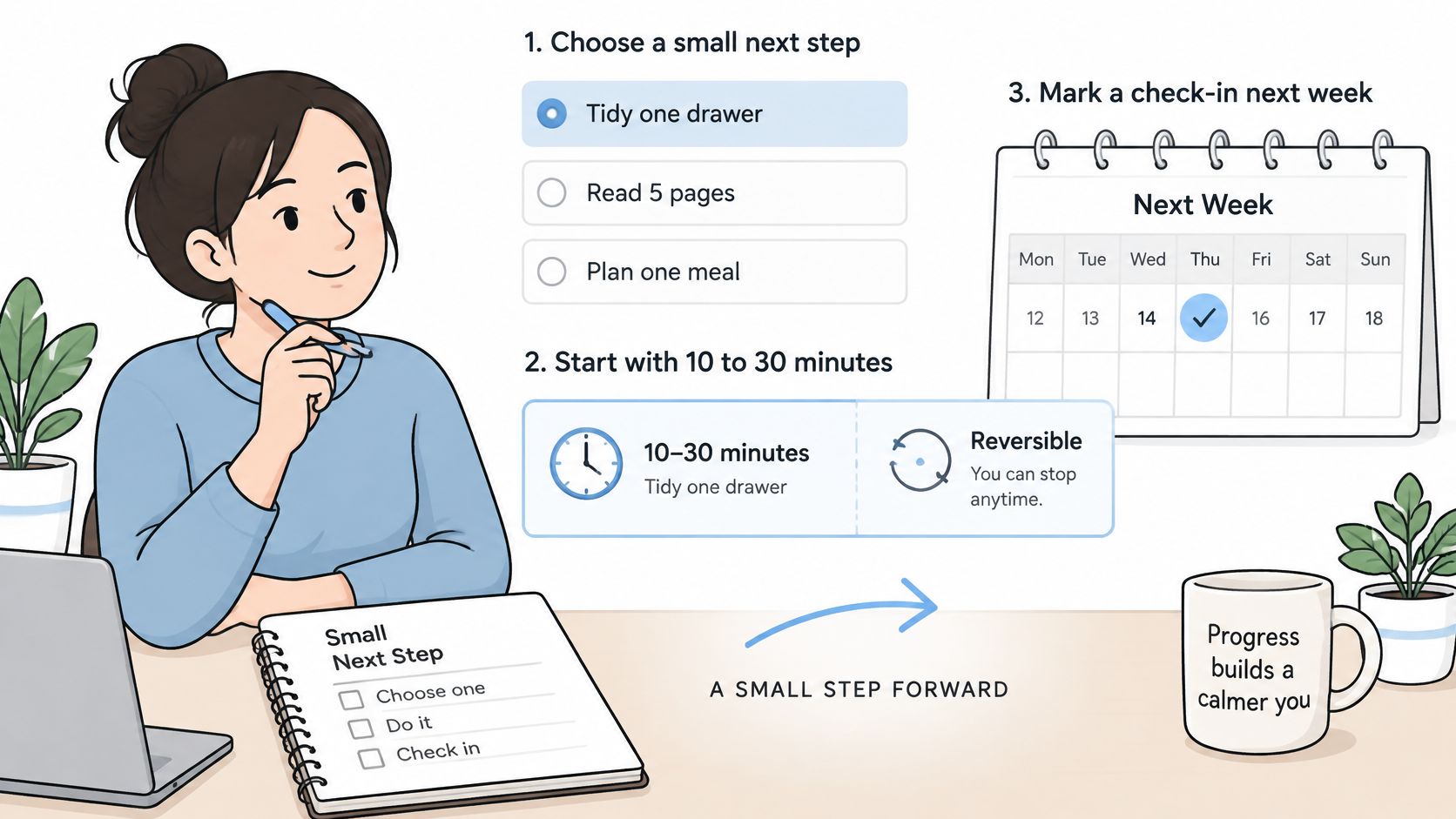
Go back to your three to five options and pick the reversible one you can begin in 10 to 30 minutes. Put it in the calendar with a day and a time, then set a check-in one or two weeks out. When that check-in arrives, answer three short questions in writing: did you do it, what did it show you, and is the step worth repeating or does it need adjusting. Written answers matter here, because a foggy "it went okay, I think" tells you nothing, and a foggy feeling was the problem you started with. If the step you want is an irreversible one, run its cheap test first: two conversations with people already in the role, or a small version of the work done on your own time.
Before you close the laptop: you do not need the whole answer, only the next step you can check.
For a walkthrough of the mindset behind small, repeatable steps, this short video covers why the tidy-one-drawer approach beats a total life overhaul.
If the stuck feeling outlasts the steps, or the decision on the table is large enough that a wrong turn would cost real money, FocusJourney offers a free 60-minute strategy call. The coach explores what is keeping you stuck, clarifies what matters most and identifies the best path forward.
Inquiries are made by email, and the coach responds within 48 hours with next steps. The steps in this article work without the call, so treat it as an option rather than a requirement.
You don't have to keep sorting this out alone in a document at 9pm. FocusJourney helps ambitious, growth-oriented people pursuing meaningful goals recognise what is interfering with their clarity and engagement, then turn it into one workable move rather than another universal productivity system. Its coaching follows the A CAR framework, which moves through Awareness, Clarity, Action and Refine to help overwhelmed professionals take back control of their time and lives. Start with the free Focus Audit, which examines six areas that shape focus, from clarity and beliefs to body and environment, so your next step comes from what is in the way. Completing it is not required before exploring coaching, and you can request the free strategy call by email through the FocusJourney website whenever you're ready to turn a foggy feeling into a decision you can check next week.