How to Deal with Competing Priorities: A 5-Step Process
Learn how to deal with competing priorities using a simple 5-step process — rank tasks, make trade-offs, and renegotiate deadlines without burning out.

A customer escalation lands at 8:40 on Monday. The launch is due Friday. The investor update was supposed to go out last week. A teammate wants twenty minutes to talk through a handoff, and the dentist appointment has already been rescheduled twice. Nothing on that list is fake, and none of it disappears because the calendar looks tidy.
That's the shape of the problem most overloaded professionals face. It isn't a missing app or a discipline defect. It's five legitimate claims on the same forty hours, plus a brain that keeps re-sorting them in the background instead of finishing any one of them.
Deal with Competing Priorities in Five Steps
Every commitment that stays mentally active charges rent. Research summarized by the American Psychological Association shows that people lose time whenever they move from one task to another, and the losses grow when the work is complex or unfamiliar. One switch costs a few tenths of a second. Thirty of them before lunch costs the morning.
Push the switching far enough and the bill can swallow the largest share of a working day. That describes a schedule where demanding work gets re-entered every few minutes, which is exactly what overloaded professionals mean when they say they were busy for nine hours and finished nothing.
Speed is the wrong fix. Getting faster at recovering from interruptions still pays the recovery cost, which is rebuilding the goal, the rules and the context after each one. The better fix is fewer live commitments, agreed openly. Competing priorities get resolved through trade-offs, and a trade-off only counts when it is stated out loud: this scope shrinks, this deadline moves, this quality bar holds.
The process, at a glance
- List every active commitment in one place. Work, promises made to other people, recurring meetings, personal obligations, and the items that live only in your head.
- Rank each item against five criteria. Strategic value, urgency, cost of delay, effort and reversibility.
- Choose one primary outcome for the current period. One result that would make the week count, chosen with full view of what it pushes out.
- Convert it into an if-then plan with a stop condition. A cue, a behavior and a defined end point.
- Defer, delegate, decline or renegotiate everything else, and say so. A deferral nobody else knows about is guilt with a due date attached.
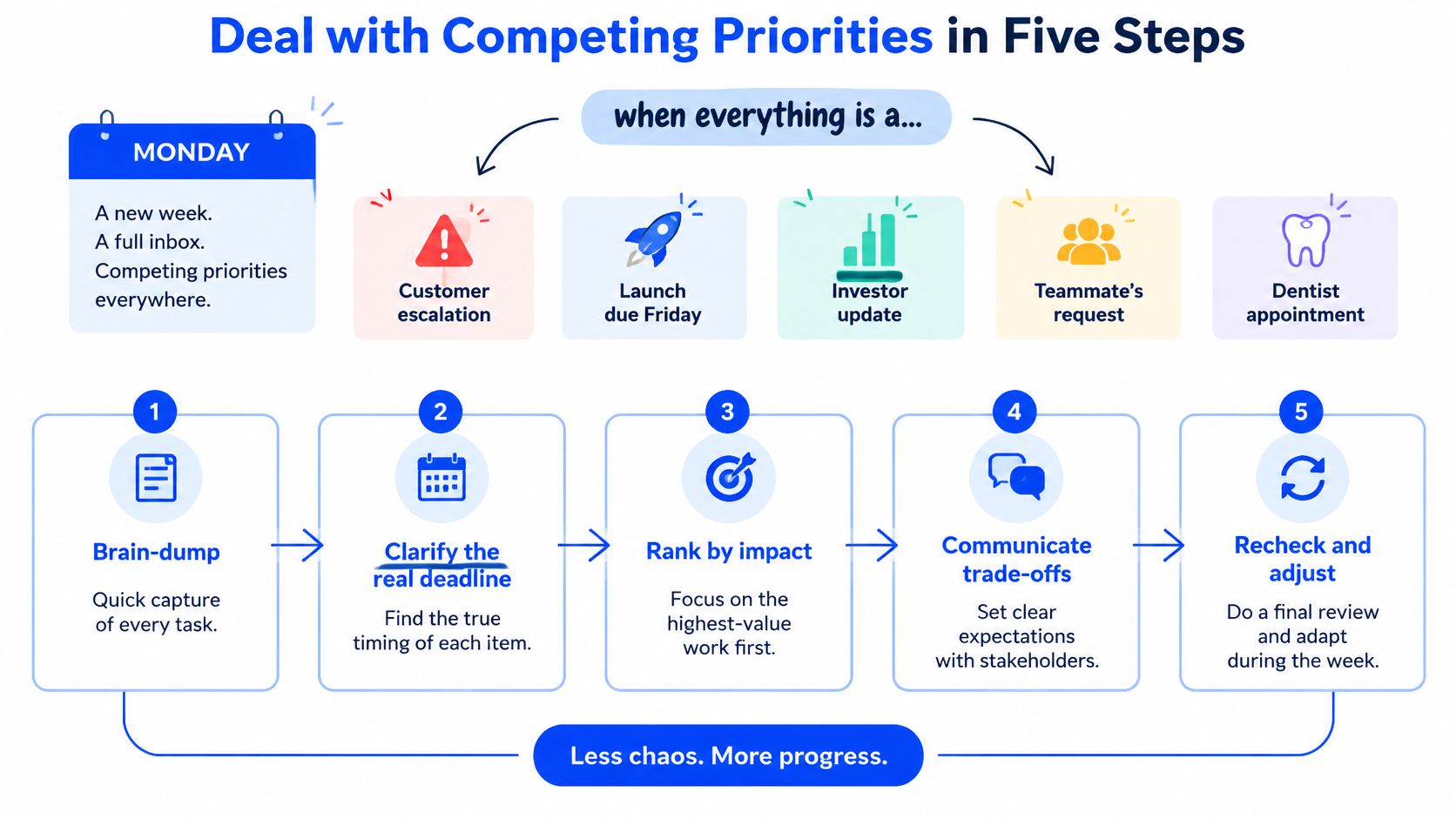
The whole run takes about 20 minutes with a pen and one list. The same sequence works for a founder with a Friday launch, an employee with three managers, and a student with four deadlines in five days, because the constraint it addresses is attention rather than job title.
What the ranking produces is a negotiation agenda, and each surviving commitment can only move on three levers: narrower scope, a later deadline or a lower bar for done. I treat the quality lever as the most underused. Plenty of deliverables ship earlier once "good enough for the decision it feeds" replaces "polished." Rerun the five steps whenever a new claim lands, because the list changes faster than the week does.
Run the Five Steps on Your Own List
Maya runs a six-person software company. Her Monday list holds a launch due Friday, an angry customer waiting on an escalation call, a monthly investor update two days late, a hiring loop for a support lead, and a school event on Thursday afternoon she has already missed once.

None of those items is optional in an obvious way, which is the trap. A list that treats all five as equal produces a week of movement in five directions and progress in none.
Start with the full brain dump
Maya writes everything onto one page: launch checklist, escalation thread, investor deck, candidate reference check, school event, plus the invisible items that never make it onto a task list, like the unread customer email from Sunday and the recurring Tuesday stand-up she keeps meaning to shorten. Promises count as commitments. So do the things only she knows about.
Score each item against five criteria
Strategic value asks whether the item moves the goal that matters most this quarter. Urgency asks whether a real deadline or another person is waiting. Cost of delay asks what gets worse if the item waits a week. Effort asks how many focused hours it needs. Reversibility asks how hard it is to undo if you start now and get it wrong.
For Maya, the launch scores high on value, urgency and cost of delay. The escalation is urgent but small in scope, since a containment reply buys the account time. The investor update is valuable and almost reversible: Monday's note with the same numbers lands just as well. The hiring loop holds medium value and survives a one-week delay without losing the candidate. The school event costs two hours and can't be rescheduled in any real sense.
When everything comes out as a ten, the criteria are being skipped rather than applied. The scoring is the point, not the scores.
Choose the one outcome that defines the week
Maya's week is a success if the launch ships. That single sentence settles four other decisions. The escalation gets a twenty-minute containment reply and a scheduled follow-up. The investor note moves to Monday at 9 a.m. The hiring loop goes onto next week's list with the reference check still attached. Thursday afternoon stays blocked for the school event.
The pressure to confuse urgency with importance is worth seeing in action before writing a plan.
Write the sentence and the stop condition
Her plan reads: if it is 9:00 a.m. and I am at my desk, then I work on the launch checklist until 10:30. The stop condition matters as much as the cue. At 10:30 she stops, notes where she landed, and only then opens email. A review point at 1:00 p.m. catches anything that slipped.
Cue-linked plans carry real weight. A meta-analysis of 94 independent studies on implementation intentions found a medium-to-large improvement in goal achievement (d = 0.65), and a broader 2024 meta-analysis covering 642 independent tests put effects between d = 0.27 and d = 0.66, strongest when the plan used a contingent if-then format and was rehearsed rather than drafted once.
Deal with the rest in writing
Deferred items get a date. Delegated items get a definition of done and a check-in date. Declined items get one polite sentence with no essay of excuses. Email gets two fixed windows, 11:30 and 4:00, so it stops leaking into every hour.
Maya's one-line plan fits on a sticky note: launch checklist 9:00 to 10:30, customer containment reply at 11:30, investor update Monday 9:00, everything else on Friday's review list.
Choose the Action for Each Commitment
A ranked list tells you what matters. It doesn't tell you what to do with the loser. Every commitment needs a disposal decision, and six cover almost every case.
| Situation | Best action | Test to apply | Example |
|---|---|---|---|
| High impact, due soon, only you can do it | Do it now | Which single outcome moves the most this week? | Finish the launch checklist before Friday |
| Important, but nothing due this week | Schedule it | Does it have a named calendar block? | Investor update blocked for Monday 9-10 a.m. |
| Urgent to someone else, low value to you | Delegate or shrink it | Can someone else do it to 80% of your standard? | Hand the status report to a teammate with a template |
| Valuable, but not now | Defer with a date | Is the revisit date written down? | Park the website redesign until March 1 |
| Neither urgent nor aligned with your goals | Decline or delete | What actually breaks if this never happens? | Turn down the optional committee seat |
| Two must-do items share one deadline | Renegotiate scope, date or quality | Which of scope, time or quality can flex? | Ship the report with three sections now, two next week |
Do it now items get the first focus block of the day, before email and before the stand-up if you can arrange it. Scheduled items only count if the calendar holds a named block with a start time; "sometime next week" is a wish, not a schedule.
The delegation row is where many people stall. The 80% rule settles it: if someone else can reach 80% of your standard with a clear definition of done, a template and a check-in date, hand it over. Waiting for a person who can do it at 100% keeps the work on your desk indefinitely.
The defer decision has more support than people expect. A six-study program published in the Journal of Experimental Psychology: General found that the more goals participants actively entertained, the more likely they were to plan to multitask, and that a larger number of active goals led them to switch tasks more frequently. The researchers also found multitasking fell when they reduced the number of simultaneously considered goals by raising one goal's relative importance. Writing a goal down for later review isn't abandoning it. It removes the goal from the active mental set, which is where the switching begins.
Every deferral needs a written revisit date on the calendar, or it turns into background hum. Declines need one sentence and no defense. Reversibility is the quiet tiebreaker on the whole table: a decision you can undo cheaply can start, while an expensive one deserves the full criteria test first.
The last row is where ranking stops working. Two genuine must-dos on one deadline can't be ordered into a solution. Something has to give, and that's a conversation rather than a productivity technique.
Scripts for Renegotiating Competing Demands
Some weeks the list isn't yours to rank. A manager, a client or a board sets the priorities, and every one arrives marked urgent. That pressure isn't imagined: in 2024, 62% of workers across 50 countries and territories reported that the pace of workplace change had increased compared with the prior year, according to PwC's Global Hopes and Fears Survey.
Demand also grows faster than capacity. A 2025 Deloitte survey of 3,150 workers, managers and executives across the United States, United Kingdom, Australia and Canada found that 68% of employees using AI reported it had increased their workload in at least one way, while 26% reported increased burnout or exhaustion. Better focus can't absorb unlimited demand. What protects you is making the trade-off visible before you take it on unnoticed.
The pattern behind every script
Name the constraint, offer two workable options, let the other person choose, then confirm the decision in writing. The choice is the part that gets you a real answer, because it hands the other person the authority they already believe they have.
"I can deliver the analysis by Friday or the deck by Wednesday, but not both at full quality this week. Which matters more?"
That sentence does what a status update can't. It exposes the capacity ceiling without complaining about it, and it ends with a question that has to be answered.
- On scope: "I can hit the deadline if we cut sections four and five, or keep the full scope and move the date to the 18th. Which do you want?"
- On a new request: "If I take this on, the onboarding revamp slips a week. Should I hand it off, push it a week, or swap it for this?"
- To a client: "Adding this by Friday means the launch assets move to next Tuesday. Which would you rather have first?"
- If you work for yourself: trade timeline against price out loud. "I can deliver by the 14th at this rate, or by the 7th with a narrower scope and a rush fee."
"That's impossible" closes a conversation. "Here is what is possible" keeps the relationship and the deadline intact, and it puts the decision where it belongs.
Close the loop with one written line: agreed, deck moves to Wednesday, analysis lands Friday. Verbal trade-offs evaporate the moment the next request arrives.
When Ranking and Time-Blocking Are Not Enough
Two situations break the process, and neither is a discipline failure.
The first is a structurally impossible load. When every item is officially urgent, the useful output isn't a tidier list, it's a visible capacity constraint: one page showing commitments, hours and deadlines, with the gap stated plainly. Show it to the person who owns the trade-off and ask which item loses.
The second is life that interrupts without warning. KPMG's 2025 Working Parents Survey found that 54% of working parents' schedules frequently clash with parenting duties, 53% struggle with ongoing childcare arrangements, and 57% identify time-management issues as a major challenge. A system built on long uninterrupted blocks assumes a week that many people never get.
Plan for reliability, not uninterrupted concentration
Resilient planning means five concrete moves. Define the minimum viable version of each priority, the smallest piece that still counts on a wrecked day. Keep a restart note with the next action, the file and the open question, so re-entry takes seconds. Hold buffer in the week rather than booking it to the edge. Treat a switch into caregiving as a planned handoff, not a failure. And count the invisible load of tracking appointments, backup care and school changes, which drains attention even on days nothing goes wrong.
The restart note isn't fussiness. In a survey of 141 developers, 97% reported needing extra time to regain focus after disruptive interruptions and 91% reported losing track of work entirely, according to research on interruption in software work.
| Symptom | Likely cause | Fix |
|---|---|---|
| Everything feels urgent | No ranking criteria and hidden overload | Rank by impact, cost of delay and reversibility, then show stakeholders the trade-off |
| You switch tasks all day | Too many goals active at once | Name one priority per block and batch email and admin into fixed windows |
| Busy days, little finished | Switching costs and rebuilt context after interruptions | Protect one uninterrupted block and log switches for two weeks |
| Caregiving or health issues wreck the plan | The plan assumes uninterrupted time | Set minimum viable progress, keep a restart note and hold a buffer |
| You agree to everything, then miss deadlines | Yes without a trade-off | Trade scope, deadline or quality out loud before accepting |
There's an honest edge case. If a ranked, renegotiated, buffered list still doesn't fit the week, the commitment set is the problem. Fewer commitments beats a better system, every time.
Pick One Priority and Protect It This Week
Four moves tonight, about 15 minutes in total.
- Write every commitment in one list, including the promises and the invisible items.
- Circle the one outcome that would make this week a win.
- Write tomorrow's if-then sentence with its time cue and its stop condition, then put it where you'll see it at 9 a.m.
- Send one renegotiation message about the item that won't get full scope, using a script from above.
If the sticking point is admitting you can't deliver everything because saying so feels like a personal failure, the work on moving past fear of failure is where that pattern gets addressed directly.
Anyone who keeps sliding back into overcommitment, distraction or burnout can book a complimentary 60-minute strategy call with FocusJourney, where the conversation starts with what's keeping them stuck and ends with practical next steps they can use straight away. Inquiries arrive by email and the coach replies within 48 hours.
Consistent focus isn't a personality trait some people are born with. It's a series of deliberate trade-offs, repeated until they become the default.
FocusJourney works with people who can hold a job and a to-do list but can't hold a straight line on the work that matters most. Coaching pairs honest conversation with practical systems for deciding what gets your attention and what gets deferred, so the week stops being a race against a list that was never realistic. Visit FocusJourney to book a complimentary 60-minute strategy call and leave with next steps you can start the same day.
Refined using the Outrank tool