Why Do I Get Distracted Easily? Causes and Fixes
Why do I get distracted easily? Learn the real causes, from unclear priorities and emotions to sleep, habits and your environment, plus simple fixes.
People who ask why do I get distracted easily often blame weak willpower. Attention is usually a signal. It points to the driver that is active right now, whether that is priorities, habits, feelings, the body, or the setup around you. A vague task, a habit check, a heavy feeling, and a tired afternoon can look identical from the outside. The useful move is to name the driver, then match the fix to it.
The Five Usual Causes of Distraction at a Glance
In 2024, 59% of surveyed U.S. employees said they could not work for 30 minutes without becoming distracted, according to workplace analytics platform Insightful's survey of 1,200 employees and employers, as reported by Fortune. That scale does not point to one shared flaw. It points to several pulls that keep restarting the clock.
Distraction is rarely a single leak. Treat it as a signal about what is winning attention in that moment. Five drivers cover most ordinary cases, and each one has a sign you can spot without a long journal.
| Likely driver | What it looks like | Quick test |
|---|---|---|
| Unclear priorities | Many open tasks and no obvious first step | Write down the single most important task for today; if you cannot, priorities are the driver |
| Habit-driven switching | Checking phone or inbox every few minutes | Count how often you switch tasks in a 30-minute block |
| Emotional avoidance | Drifting to easy tasks when a task feels heavy | Note the feeling you had just before you switched |
| Biology and energy | Foggy after poor sleep, skipped meals or long screen days | Compare your focus on a rested day with a tired day |
| Environment and setup | Noise, open tabs and alerts within reach | Remove one cue and measure time on task |
Unclear priorities leave the next step unnamed, so the nearest task wins. Habit-driven switching is the inbox or phone check that starts before the work does. Emotional avoidance steers you toward something lighter when the task feels heavy. Biology and energy sag after poor sleep, a skipped meal, or a long sit. Environment and setup keep noise, tabs, and alerts close enough to grab.
Practical rule: Look at your last three distractions and mark the driver that shows up most. Work on that one before you redesign the whole day.
The tests are small on purpose. You do not need a perfect label. You need the driver that repeats, then one change aimed at that driver.
Why Unclear Priorities and Overload Pull Your Focus Away
Attention is like a ship with no chosen course. It drifts toward whatever is closest or easiest, even when that stop was never the plan. Work that looks busy can still be off course if you never named the destination.
In 2024, excessive workload was identified by 38% of surveyed knowledge workers as a workplace distraction, while unnecessary meetings and workspace distractions each affected 36%, in a survey of more than 2,000 U.S. and U.K. knowledge workers conducted by GWI for reMarkable. Overload does not only add hours. It multiplies open loops, and each loop competes for the same attention.
Signs the course was never set
Three signs show up together more often than people expect.
- Too many open projects: Several efforts stay half alive, so each one keeps a claim on your mind.
- A list with no top item: Everything looks equally urgent, which means nothing is first.
- Yes to every request: New work lands before yesterday's work has a next step.
A ten second priority test
Write down the single most important task for today. If you cannot, priorities are likely the driver. When the first step is fuzzy, email and small chores feel productive because they have a clear ending.
- List everything currently open. Seeing the full set stops hidden tasks from popping up as fake emergencies.
- Mark the one task that moves your main goal forward. One named task gives the ship a heading for the next block of work.
- Cap active projects at three. Fewer open loops means fewer competing pulls during the day.
- Decline, delay, or schedule one request this week. A boundary protects the task you already chose. If several goals keep colliding, a clearer pass at how to deal with competing priorities can help you sort what stays active.
Before you log off today, write tomorrow's first task in one sentence. Morning you should not have to negotiate the course again.
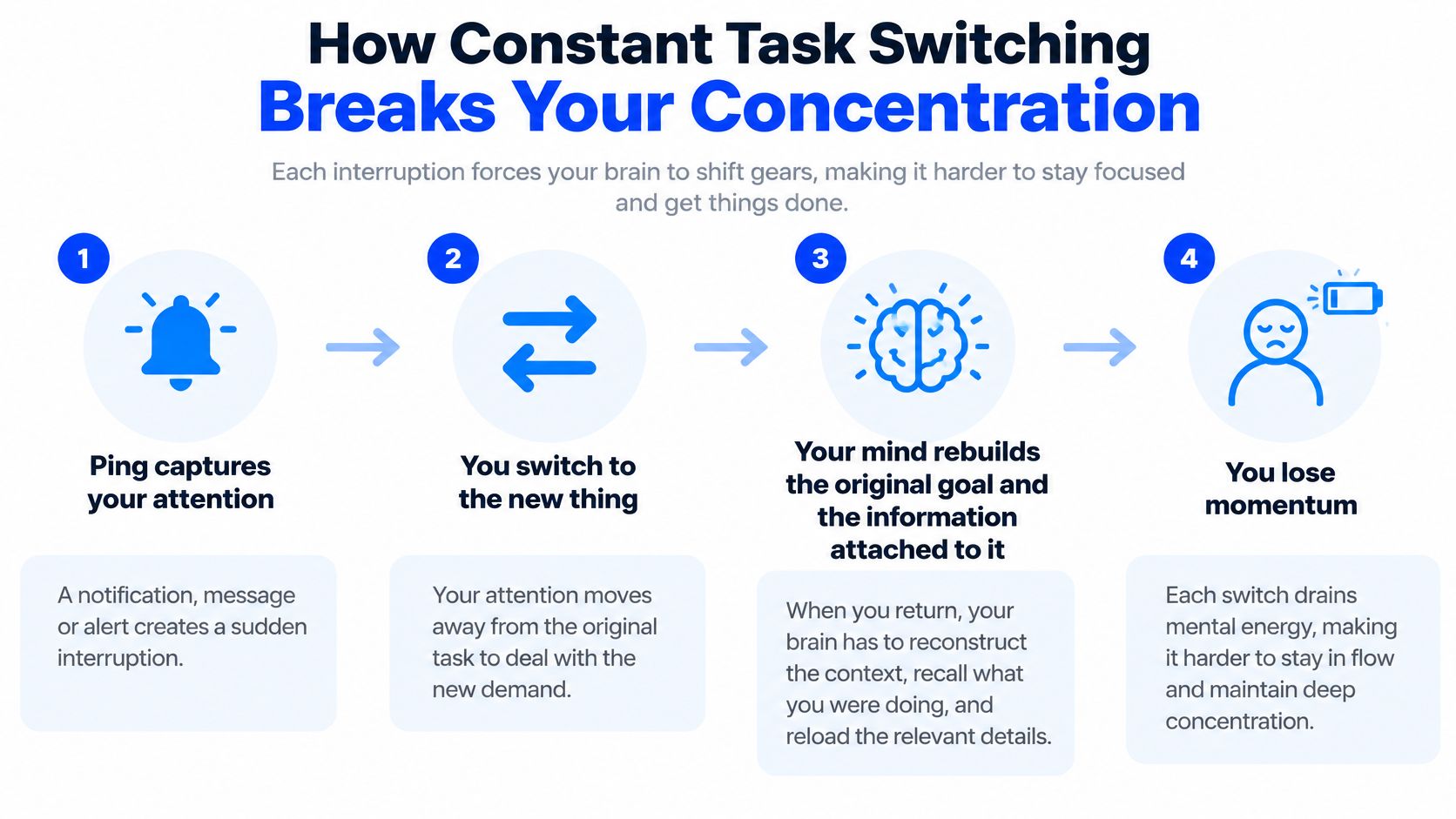
How Constant Task Switching Breaks Your Concentration
Say you open a message “for one second.” The reply needs a file. The file sits in another thread. Ten minutes later the original task feels cold, and starting again takes more effort than the message ever did.
The cycle has four stages.
- A ping captures your attention. A notification, a thought, or a colleague's question cuts into the task.
- You switch to the new thing. The original work stops, even if you meant to return immediately.
- Your mind rebuilds the original goal and the information attached to it. You have to recall where you were, what the next line was, and why it mattered.
- You return, often later than you meant to. Momentum is thinner, and the new activity still tugs.
What a short check actually costs
A field study of information workers, published by Microsoft Research, found that after an interruption workers typically visited about 2.26 other work activities before returning to the original task. In the same research, only 77.2% of interrupted work segments were resumed on the same day, and the average return time was approximately 25 minutes and 26 seconds.
Exact delays are not the same for every person or every ping. The pattern is the point. A short interruption can cost far more than its length because you must also get past the appeal of the new activity.
A one-second check is cheap. Rebuilding the task is not.
Three changes match that pattern. Batch messages into two or three set windows so the inbox is a planned stop, not a reflex. Turn off nonessential alerts so fewer pings start the cycle. Before you step away, write the next concrete action on the task itself, so the return has a handle waiting.
How Stress, Boredom and Avoidance Trigger Distraction
A hard email can make a silent phone look loud. The task feels vague, tense, or dull, and relief is one swipe away. Stress and boredom work like weather inside the body: when the feeling changes, attention looks for a safer room.
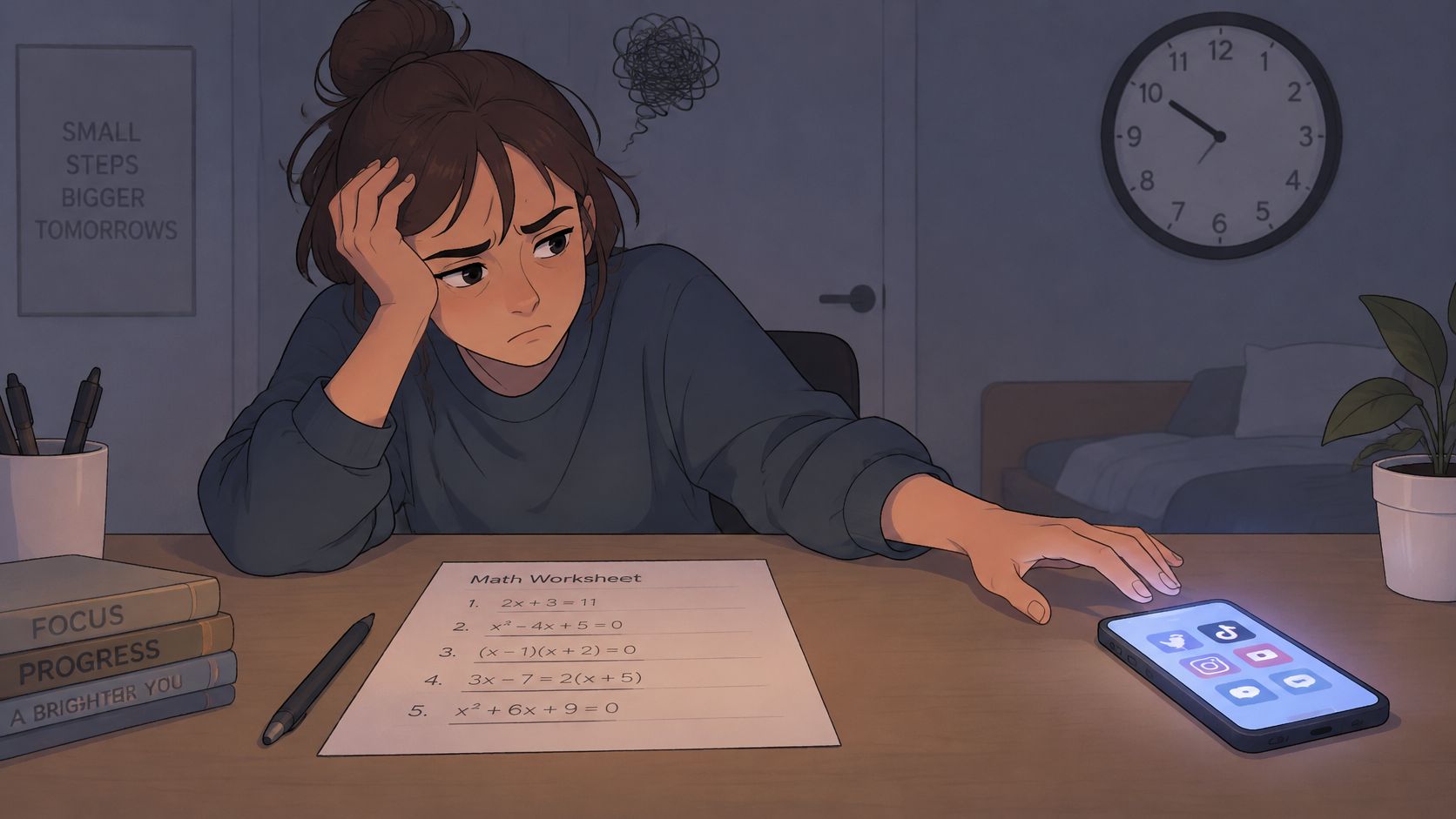
A 2025 workplace study found that participants left their main task every 3.5 minutes on average, with self-initiated interruptions accounting for nearly 60% of off-task time. The same study links negative emotions, stress, and insufficient sleep with more self-interruption and poorer attention. In plain terms, many exits start inside the person before any outside ping arrives.
That makes the phone a clue. If the switch follows a tight chest, a boring stretch, or a stuck sentence, the distraction is naming an active driver. App blockers can mute cues and slow the escape route. They do not settle anxiety, exhaustion, or avoidance by themselves.
Three questions before you blame the phone
Use this short check the next time you drift.
- What happened just before you switched? Name the task, the message, or the exact stuck point.
- What did you feel, or notice in your body? Tight chest, restlessness, boredom, and dread are different signals.
- Were you avoiding a task, seeking stimulation, or compensating for tiredness? The function of the switch points to the fix. When the feeling is fear that the work will not be good enough, it helps to look at how to overcome fear of failure rather than only hiding the apps.
Then answer in three small moves. Name the feeling in one word. Take a two-minute reset, such as a few slow breaths or a short walk. Return with a smaller first step, like one paragraph, one email, or one line of the outline.
The goal is not perfect focus. The goal is catching the moment attention leaves, hearing what it was carrying, and giving that driver a direct response.
How Sleep, Energy and Body Basics Shape Attention
Attention is a physical resource. When the body is short on sleep, fuel, or movement, holding a task takes more effort, and the mind wanders sooner. Willpower talk misses that cost.
Picture a late night, then a rushed morning with no breakfast. Lunch waits until mid-afternoon. You sit through the whole day, drink little water, and wonder why the afternoon draft will not hold. The work did not suddenly get harder. The body that has to do it is running low.
A simple comparison you can run this week
On a well-rested day, note how long you can stay with one task before you drift. On a short-sleep day, note the same thing. If the gap is large, energy is part of the driver, even if your to-do list did not change.
- Keep a consistent wake time. A steady start makes the first work block less foggy.
- Take a 10-minute walk before the hardest task. A short move can make the first minutes easier to enter.
- Eat a meal with protein and fiber before deep work. Steady fuel beats a long empty stretch.
- Drink water through the morning. Thirst is an easy cue to miss until focus is already thin.
- Set a screen cut-off before bed. Late scrolling pushes sleep later, and the next day pays for it.
These habits support attention. They do not replace care for a sleep disorder or another medical condition. If focus stays poor after several weeks of steadier sleep, food, and movement, look at whether the pattern is bigger than a bad week.
How Your Environment and Setup Invite Distraction
Some cues do the pulling before you decide anything. A phone face-up on the desk, twelve open browser tabs, banner alerts, a noisy room, a cluttered surface, or a seat facing the door can each restart the urge. You can resist a cue once. Resisting it every few minutes is a losing job.
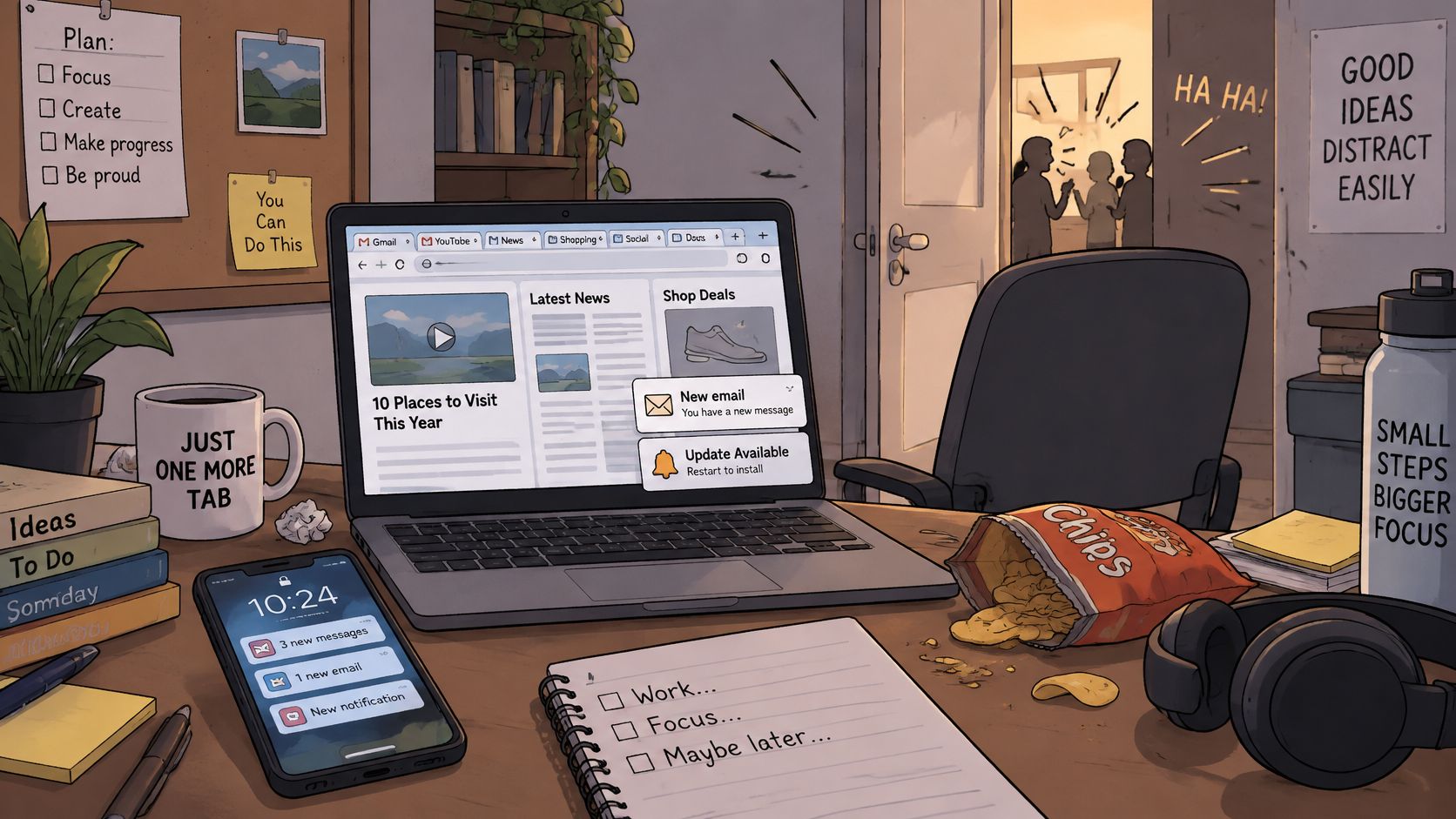
Removing the cue is easier than arguing with it. The setup should make the task the nearest option.
- Put the phone out of sight, ideally in another room, so a dark screen is not a standing invitation.
- Close tabs the current task does not need. Extra tabs are unfinished doors.
- Turn off badges and banners for apps you do not need in real time. Keep only what would change your next hour.
- Choose a quieter spot, or use headphones, for the focused block. Less noise means fewer accidental switches.
- Write one visible task on paper where you will see it. Paper does not open a new feed.
Say a writer moves the phone to another room and closes everything except the draft. The first half hour is often smoother because nothing on the desk asks for a detour. The same idea shows up in practical advice on how to stay focused at work: change the scene, then do the work.
One change, then a short work block
Run a 25-minute test. Make one change, work on one task, and count how many times you return to it without a detour. If that helped, repeat tomorrow with a second change. Stacking five fixes at once makes it hard to see which cue mattered.
When Frequent Distraction May Point to Something More
Self-diagnosis from a rough week is unreliable. In one 2026 sample of 232 adults seeking ADHD evaluation, 64.2% received an ADHD diagnosis, meaning more than one-third did not, according to assessment data in CNS Spectrums. In that sample, childhood inattention was the only DIVA interview score significantly associated with the final diagnosis.
A busy season, a new job, or a string of short nights can mimic a lasting problem. Persistent inattention deserves a wider look: settings, developmental history, sleep, mood, stress, medication or substance use, and real impact on daily life. Short-form content habits alone do not settle the question. Nighttime digital media is also tied, in broader research, to later sleep and poorer next-day function, which can imitate a focus disorder without being one.
| Feature | Situational distraction | Persistent pattern worth assessing |
|---|---|---|
| Duration | Comes and goes with stress, fatigue or a busy period | Present most days over several months |
| Onset | Linked to a recent change in work, sleep or life | Noticed since childhood or early school years |
| Settings | Mainly in one context, such as a noisy office | Shows up at work, at home and while studying |
| Impact | Work slips but recovers when conditions improve | Causes repeated problems with work, relationships, money or safety |
| Next step | Adjust priorities, habits, body basics and environment | Arrange an assessment with a qualified clinician |
Red flags worth a real assessment
Watch for distraction that causes serious problems at work, in study, in relationships, or for safety. Also watch symptoms that began in childhood and continue across several areas of life. ADHD is one possibility among several. A qualified clinician can sort it from mood, sleep, stress, and other explanations.
Coaching can support habits, priorities, and self-awareness. It cannot diagnose a condition.
If the pattern is persistent and impairing, book an evaluation. If it rises and falls with a deadline or a bad sleep week, start with the matching everyday driver instead of a label.
Pick One Cause and Test It This Week
Guessing at five fixes at once hides what helped. One driver, one change, and a simple tally tell you more.
- Choose the one driver from the first table that matched your last three distractions.
- Make one change tied to that driver for seven days. That might be a fixed priority list, a phone outside the room, or a set wind-down time.
- Keep a simple tally of each time you drift and what came just before it.
- Review after a week. If the tally fell, keep the change. If it did not, test the next driver.
If you cannot tell which driver is active, the free Focus Audit from FocusJourney asks about six areas, clarity, knowledge, beliefs, discomfort, body, and environment, so you can see which one needs attention first. FocusJourney uses the A CAR framework, which stands for Awareness, Clarity, Action, and Refine, to help overwhelmed professionals take back control of their time and lives. The Awareness phase addresses immediate and urgent challenges holding the client back and identifies which urgent problems to work on first. If you want help working through the list, 1:1 coaching is available. It supports habits, priorities, and self-awareness, and it does not diagnose anything.
The decision for today is small. Pick one cause, change one thing, and track it for seven days.
FocusJourney helps people who keep asking why do I get distracted easily identify the driver, then build a focus practice that fits their work and life. The free Focus Audit and 1:1 coaching are there when a single weekly test is not enough and you want a clearer next step. Visit FocusJourney to start with the audit or explore coaching.
Powered by Outrank app