How to Overcome Fear of Failure in 5 Simple Steps
Learn how to overcome fear of failure with a 5-step method: test the expectations behind it, calm the discomfort, and take one small bold action this week.
The deck is finished. It has been finished for six weeks, and it has been rebuilt twice since. The email to the first investor sits in drafts, and every day it stays there the deck gains a slightly nicer chart. Meanwhile a professional with twelve years of experience studies the stretch assignment on the internal job board, imagines the first month going badly, and closes the tab. Both people are working hard. Neither one is working on the thing that would tell them something true.
That gap is what fear of failure does. It doesn't announce itself as fear. It arrives as polish, as research, as one more round of preparation, as a calendar that is suddenly full of useful small tasks. Underneath sits a single sentence the person would rather not read out loud: this will prove I'm not good enough.
Confidence isn't the fix, and neither is a pep talk. Confidence tends to arrive after the attempt, not before it. What moves people is a sequence: name the specific outcome being feared, test the expectation behind it, take a step small enough that refusing it looks silly, act before the feeling settles, and review what happened. That sequence gets a full walkthrough below, followed by the deeper work on hidden expectations, the physical spike of discomfort, the difference between fear as a verdict and fear as risk data, and the way a founder's fear travels through a team without anyone deciding to spread it.
What Fear of Failure Is Really Telling You
Fear of failure is rarely about the failure event itself. A lost client, a rejection email, a launch that lands flat: those cost time and money, and they're survivable. What the mind flinches from is the meaning attached to them. This proves I'm not good enough. This proves the idea was silly. This proves the people who doubted me were right. Those are identity forecasts, and identity forecasts can't be tested, which is exactly why they're so effective at stopping people.
Because the fear is about meaning rather than consequence, it never shows up saying "I'm scared." It shows up as behavior:
- Endless preparation: the deck, the logo, the fourth round of customer interviews, anything that can be labeled getting ready.
- Procrastination on the one task that carries risk: the pitch email, the portfolio upload, the price increase notice.
- A calendar full of safe work: long days, tired evenings, zero exposure.
- Abandonment just before judgment: the project dies two weeks before the launch, the review, or the deadline that would settle it.
The tell is the rescue story. As soon as something gets close to being judged, a reasonable-sounding reason appears to delay it. The market is soft. The timing is off. One more feature would make it stronger. Reasonable reasons are the most expensive form of avoidance, because they're convincing enough to survive an honest self-audit.
Practical rule: If a task has been almost ready for more than two weeks, the delay stopped being about the task a long time ago.
The short version of the fix: name the specific feared outcome, test the expectation behind it, and take a step small enough to start within 48 hours. Everything else in this guide is that instruction, applied with more precision.
How to Overcome Fear of Failure in 5 Steps
Take Maya, a product designer who has rewritten the same portfolio four times and shown it to nobody. Her fear isn't vague. It's a sentence: if the work gets criticized, it proves she's a fraud. Each step below shrinks that sentence until it can be tested.
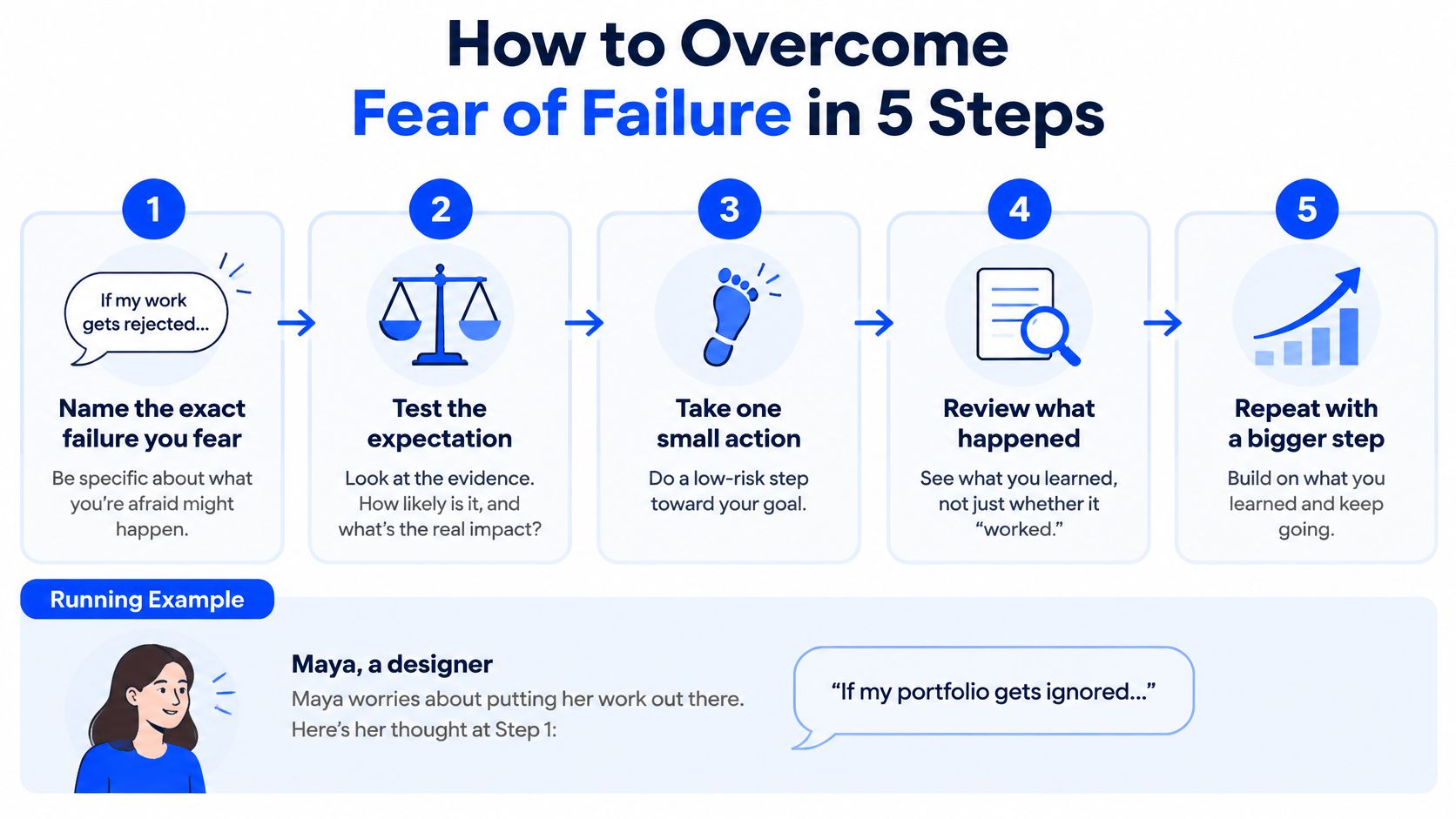
1. Name the exact failure you fear. Write one sentence, no hedging, no softening: "If my work gets criticized, it proves I'm a fraud." Vague dread can't be tested and can't be argued with. A written sentence can be examined, and it usually looks shakier in daylight than it did at 2 a.m.
2. Separate the story from the stake. Two columns on one page. What is at risk (three evenings of work, the price of a domain, one person's opinion), and what the mind invented (everyone in the industry will see it, and they'll all know). The invented column is almost always larger. Splitting them turns a verdict into a budget.
3. Shrink the first move. Not "launch the portfolio" but "publish one case study." Not "raise money" but "send one email." The test is simple: refusal should feel faintly absurd. Put a 48-hour deadline on it, because a small task with no date is a small task that never happens.
4. Act while afraid. Do the task before the feeling resolves, and decide in advance what data counts either way. For Maya that's opens, replies, whether anyone asks a follow-up question, and one honest reaction from a designer whose taste she trusts. Confidence is a lagging indicator. It shows up after evidence, not before.
5. Review like a scientist. Three questions in a notebook: what worked, what surprised me, what's the next smallest test. Then update the plan. Never update the identity. "The case study got two replies and no interview" is data. "I'm not a real designer" is a story wearing a lab coat.
Why the steps run in this order
Step one exists because untested fears stay enormous. Step two exists because people often fail to separate a survivable cost from an imagined catastrophe, so they price the attempt wrong and never take it. Step three is where action becomes possible again.
Steps four and five are what separate people who build a track record from people who collect one-off attempts. Acting while afraid generates evidence. Reviewing that evidence is what turns one uncomfortable email into a repeatable method. Skip the review and the same fear returns at the next milestone with no new information to fight it.
Examine the Expectations That Feed Your Fear
Fear stays alive on expectations nobody wrote down. Put them on paper, and each one becomes a testable question instead of a permanent condition.
| Expectation pattern | What it sounds like | The test that loosens it |
|---|---|---|
| Perfectionism | "If it isn't flawless, it's a failure" | Define "good enough to learn from" before starting and ship at that line |
| All-or-nothing thinking | "One flop undoes everything I built" | List what survives a failure: skills, relationships, data, runway |
| Mind reading | "Everyone will see I'm a fraud" | Ask one trusted person for their actual reaction to the work |
| Fixed ability | "Failure proves I'm not talented" | Ask which strategy, support or effort to change before the next attempt |
| Comparison | "They succeeded faster, so I'm behind" | Measure against your own last attempt, not someone's highlight reel |
Why reframing works better than willpower
The strongest evidence for this table doesn't come from a boardroom. A national experiment assigned roughly 12,000 ninth-grade students across 65 U.S. schools to a brief online program, under an hour long, teaching that intellectual ability develops through effective strategies, support and effort. It reduced fixed-mindset beliefs, with results reported for 5,650 students showing a statistically significant change. Academic effects concentrated among the students most vulnerable to discouragement: lower-achieving students in the program earned core-course GPAs about 0.10 points higher than comparable control students, based on 6,320 students, and the program increased enrollment in advanced mathematics, according to the What Works Clearinghouse study record. In the full sample, the reported GPA comparison was 2.59 versus 2.55, and students with a ninth-grade GPA of 1.0 or lower were less common in the intervention group, 29.72% versus 32.09%.
The mechanism matters more than the decimal points. What changed for those students wasn't confidence. It was interpretation. A setback stopped being a verdict about ability and became information about strategy, and once that shift happened, harder courses looked less like exposure and more like practice.
That's why reframing outperforms willpower. Willpower asks someone to push through a threat response, and threat responses don't take orders. A new interpretation removes the threat, and the effort follows on its own. The reframe isn't positive thinking either. It's closer to triage: what part of this was the strategy, what part was the support, what part was the amount of effort, and which one gets changed next.
Replace "failure proves I can't do this" with "what can I learn or change next?" The first sentence closes a story. The second opens a test.
Respond to the Discomfort Without Backing Down
The moment before the feared task isn't a thinking problem. Heart rate climbs, attention narrows, and the mind offers a reasonable case for doing this tomorrow. Four tools work inside that window.
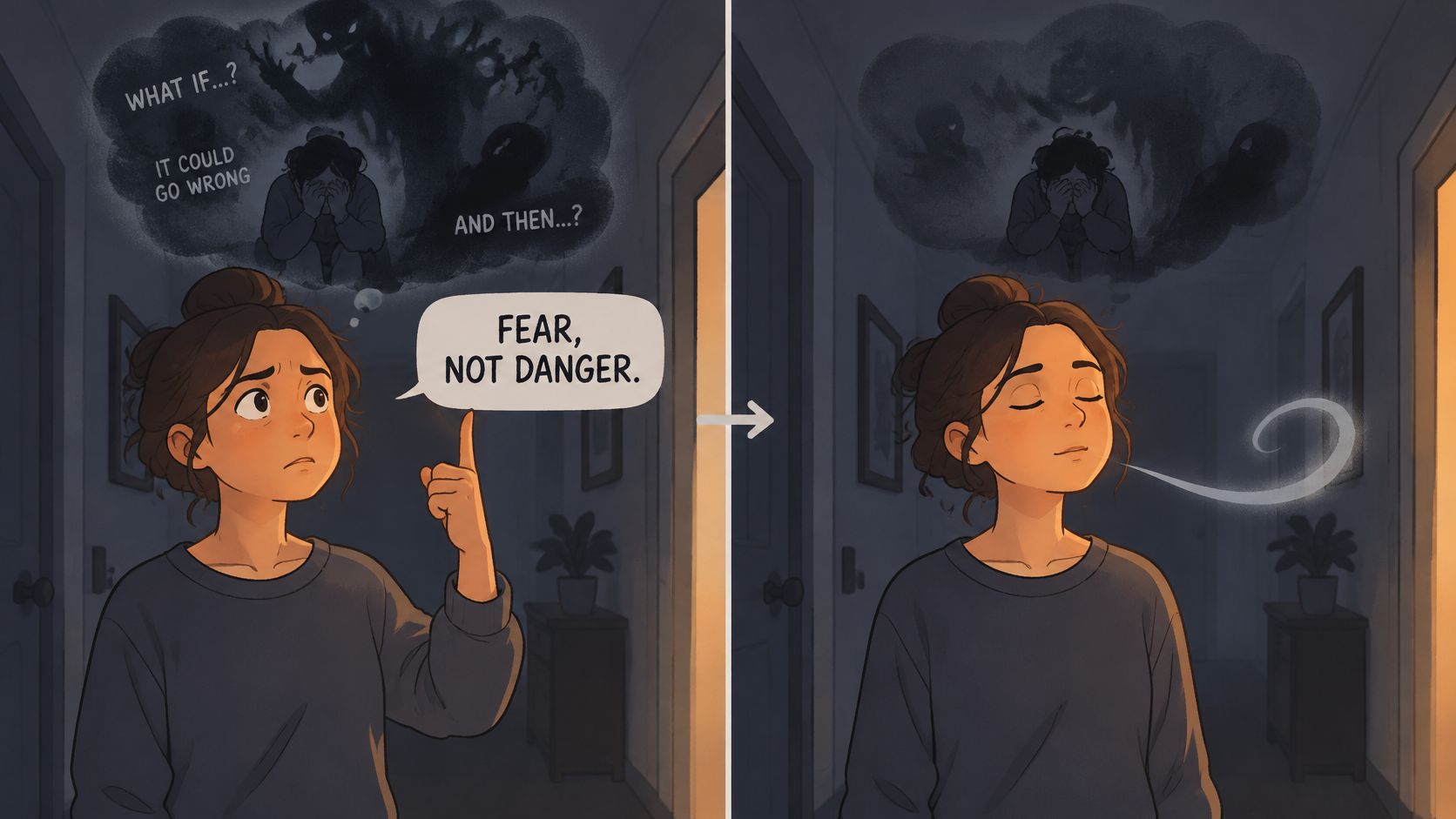
Name the state. Say it plainly: this is fear responding to a possible story, not a present danger. Labeling moves the experience from "something is wrong with me" to "something is happening in me," and that small distance is often enough to keep a hand on the keyboard.
Lengthen the exhale. Two minutes of 4-4-6 breathing: inhale for four counts, hold for four, exhale for six. Ten slow counted breaths work too. The long exhale carries the signal; it's faster than any mental argument and it doesn't require belief.
Use the ten-minute rule. Commit to ten minutes of the avoided task, with explicit permission to stop at the end. Ten minutes on the pricing page, ten minutes on the first paragraph of the pitch. Often the momentum carries you further. The ones who stop have still broken the freeze, which was the actual obstacle.
Run a three-line script after a setback. Facts first: "the launch got twelve signups, not a hundred." Then the sting, without self-attack: "this hurts, and it's an ordinary human response." Then one lesson: "the headline needs testing." Three lines, ninety seconds, and the goal isn't to feel better. It's to stay in contact with the work.
That sequence is backed by more than intuition. In a study of 222 participants, self-compassion was positively related to mastery goals focused on improving competence and negatively related to performance goals centered on proving worth to others, a link partly explained by lower fear of failure and greater perceived competence, as reported in the self-compassion and learning goals research. Among 110 students who believed they had failed a midterm, higher self-compassion meant more emotion-focused coping and less avoidance-oriented coping. A short self-compassionate writing exercise also reduced beliefs that failure is aversive and should be avoided.
Performance rule: Self-kindness isn't a lower standard. It's what keeps someone in the room long enough to meet the standard.
For a short walkthrough of staying with discomfort instead of negotiating with it, this is worth a few minutes.
Turn Fear Into Risk Information at the Right Stage
Most advice treats fear as a malfunction to be switched off. That advice fails founders in one specific way: it collapses two different situations into one. Fear before a commitment and fear after a commitment call for opposite responses.
A 2025 analysis spanning 89 countries found that collective fear of failure behaved differently across entrepreneurial stages. It reduced entrepreneurial intentions and opportunity-seeking before launch, yet it was positively associated with later-stage entrepreneurial activity aimed at growth and innovation, according to the cross-country entrepreneurship study. The same emotion helps or hurts depending on where the person stands. That makes the useful question narrower than "how do I stop being afraid": when should this fear be reduced, and when should it be read as information?
Three questions to run before a big commitment
- Is this a constraint or an embarrassment? Runway, a skill gap, a licensing requirement and a saturated market are constraints. Looking naive in front of a former colleague is an embarrassment. Constraints need a plan. Embarrassments need exposure.
- What evidence would change the answer? If nothing could, this isn't a risk assessment. It's a belief doing an impression of one.
- What's the cheapest experiment that produces that evidence? A pre-sale page, five customer calls, a paid pilot, one week of selling before building. Cheapest means fastest to a real answer, not smallest in effort.
| Signal | Fear-driven avoidance | Legitimate risk |
|---|---|---|
| Timing | "I'll launch when I feel more confident" | "I need three more months of runway saved first" |
| Evidence | "It probably won't work, so why start" | "Only 2 of 20 target customers said they would pay" |
| Scope | "One more feature before anyone sees it" | "Compliance requires certification before we can sell" |
| Identity | "A real founder wouldn't feel this scared" | "My sales skills need training or a partner before scaling" |
| Feedback | "Criticism means the idea is dead" | "Three testers flagged the same pricing objection" |
After you commit, convert fear into safeguards
Once the decision is made, suppression is the wrong move. Set a stop-loss number before the first dollar goes out. Pick a review date in the calendar and honor it whether the news is good or bad. Fix an experiment budget so spending more requires a decision rather than a mood.
Fear at that stage is usually about exposure, and exposure gets managed. It gets a threshold, a date, and a limit. That's the shift worth making: fear stops being a verdict about personal worth and becomes feedback about the next test.
Keep Fear From Spreading Through Your Team
Fear is contagious in a way spreadsheets aren't. A 2025 study in the Journal of Business Research examined entrepreneurs' fear of failure as an influence on employees and found a negative relationship with employee satisfaction, and that relationship was stronger when strategic decision making was less participative or when the entrepreneur had a weaker internal locus of control, as recorded in the Journal of Business Research listing.
The uncomfortable part is that nobody decides to do this. A founder can look productive, ship on time, run tight meetings, and still teach a team that bad news is expensive to deliver. People don't need a memo to learn which topics end a career conversation.
Four behaviors are observable and fixable:
- Separate uncertainty from catastrophe, out loud. "We don't know if this will work. This is what we'll measure, and here's when we'll decide." Naming the unknown removes the implication that the unknown is fatal.
- Invite dissent before the decision closes. Ask one person, by name, to argue the opposite case. Doing it once sets a norm. Doing it every time makes disagreement cheap.
- Make small experiments safe to report. Blameless reviews ask what was learned, not who missed it. A team that expects a verdict on the person will report results late and cleaned up.
- Audit your own signals. Cancelled one-on-ones, rushed replies, a visible sigh at bad news. Teams read those as verdicts and adjust what they bring, usually by bringing less.
Managing your own fear isn't private hygiene. It decides whether people bring you problems early or hide them until they're expensive.
Put the Plan to Work This Week
A plan that takes a month to design won't survive a bad Tuesday. Keep the first week to one action per day, each small enough to finish on a day that goes wrong. By Friday you should hold something better than motivation: a written record your fear has to answer.
| Day | Action | Output |
|---|---|---|
| Day 1 | Write your fear sentence and run it through the expectation table | One named fear and one tested expectation |
| Day 2 | Draw the "good enough to learn from" line and set the next move with a 48-hour deadline | Written standard and dated deadline |
| Day 3 | Do the ten-minute version of the avoided task | Honest record of what actually happened |
| Day 4 | Hold a five-minute review with the three learning questions | Lessons learned and one update to the plan |
| Days 5-7 | Repeat with the next smallest test | Running evidence log of attempts |
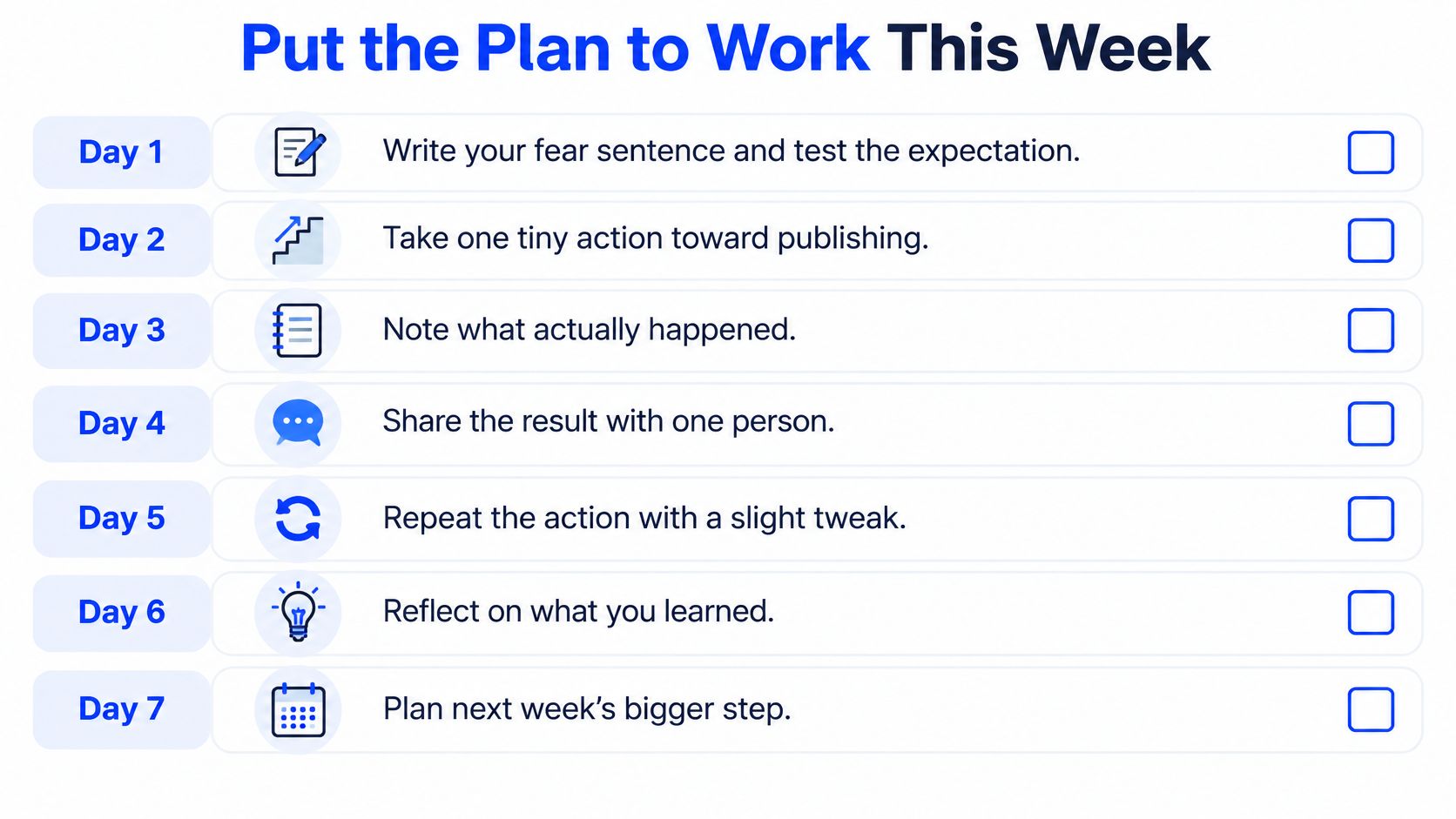
Three things keep the week from collapsing. Tell one person the deadline, because a commitment witnessed survives a low-energy afternoon. Reward the attempt, since the outcome is the part nobody controls. And re-read the evidence log whenever the "not cut out for this" story returns, because written attempts are harder to argue with than memory.
If fear still wins after an honest week, more planning will not fix it. Planning is avoidance wearing a project manager's jacket. Go back to the exact step where the stall happened, whether that is naming the fear, the discomfort tools, or the expectation test, and run it once more on the smallest real task available.
The earlier sections all feed this week. Before a big commitment the fear sentence reads as a verdict, and Day 1 tests it. Afterward, the same log turns into risk data you can act on. Either way the week trades an opinion about you for a record of behavior, and a record can be beaten.
FocusJourney's free 60-minute strategy call is built for exactly this point. It explores what is keeping you stuck, clarifies what matters most, and identifies the best path forward, so you leave with clarity and practical next steps you can begin immediately. If the steps are clear and the sticking point is the first move, it is the fastest conversation available with a coach who has spent years helping people through career decisions, procrastination, and overwhelm. Book the free 60-minute strategy call on the FocusJourney website and pick your smallest test this week.
Prepared with Outrank tool